Graft Calculator
Hair Transplant Graft Calculator for Accurate Results
Planning a hair transplant starts with knowing how many grafts you need. Our hair transplant graft calculator helps patients and surgeons estimate the optimal number of hair grafts for successful restoration surgery.
Get your personalized graft estimate in under 60 seconds. This advanced tool analyzes your balding area size, desired density, and hair characteristics to provide accurate estimates—giving you a clear starting point before your consultation.
Quick Answer: How Many Grafts Do I Need?
| Hair Loss Stage |
Norwood Scale |
Grafts Needed |
Turkey Cost (€) |
| Mild | Norwood 2-3 | 1,500-2,500 | €1,500-€2,500 |
| Moderate | Norwood 3-4 | 2,500-3,500 | €2,000-€3,500 |
| Advanced | Norwood 5-6 | 3,500-5,000 | €2,500-€4,000 |
| Severe | Norwood 6-7 | 5,000-6,000+ | €3,000-€4,500 |
Use the calculator above to get your personalized estimate. Online calculators achieve 40-60% accuracy—a surgeon consultation achieves 90-95% accuracy by evaluating your donor area, scalp laxity, and future hair loss patterns.
What is a hair transplant graft calculator?
A hair transplant graft calculator (also called a baldness calculator or FUE cost estimator) is an online assessment tool that helps patients estimate the number of grafts needed for hair restoration.
The calculator analyzes your inputs about hair loss pattern, hair characteristics, and timeline to provide a rough graft estimate. Most calculators require:
- Hair loss pattern (selecting affected areas on a scalp diagram)
- Current hair density in thinning areas
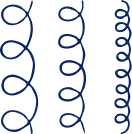
- Hair characteristics (straight, wavy, curly, coily)
- Patient age
- Hair loss duration
While graft calculators provide useful estimates, they cannot replace professional hair and scalp analysis. The actual number of grafts can only be determined through in-person consultation where a surgeon assesses:
- Donor area capacity and density
- Scalp elasticity (laxity)
- Hair loss progression rate
- Individual surgical limitations
- Future hair loss potential
- Overall restoration goals
What is a hair graft?
A hair graft is a small tissue unit containing 1 to 4 hair follicles extracted from the donor area (typically the back or sides of the head) during hair transplant surgery.
Each graft includes the complete hair follicle structure, surrounding tissue, and essential components needed for hair growth. Once transplanted, grafts establish blood supply in their new location and produce hair permanently, following the same growth cycle as their original position.
Graft types:
- Single-hair grafts: Used at the hairline for natural appearance
- Double-hair grafts: Used in mid-scalp for density
- Triple/quad grafts: Used in crown for maximum coverage
What are hair graft extraction techniques?
Surgeons use two primary methods for graft extraction:
- Follicular Unit Extraction (FUE): Harvests individual grafts with a micro punch (0.6-1.0mm). No linear scar, but limited to 2,000-4,000 grafts per session.
- Follicular Unit Transplantation (FUT): Removes a strip of scalp that is dissected into grafts. Can yield 4,000-5,000 grafts but leaves a linear scar.
The extraction method influences graft survival rates, implantation density, and aesthetic outcomes. Surgeons choose based on the patient's hair loss pattern, donor area viability, and scalp laxity.
How does a graft calculator work?
A hair graft calculator works by analyzing your hair loss pattern, current hair density, hair characteristics, and age. You select thinning areas on a digital scalp diagram and enter details about your hair texture and thickness. The calculator uses this information to estimate how many grafts you need for natural coverage.
The calculator applies a formula based on key hair restoration principles:
- Area calculation: Measures balding area in square centimeters (cm²)
- Density target: Typically 40-60 grafts per cm² for natural-looking results
- Hair type adjustment: Curly hair provides more coverage per graft than straight hair
- Age factor: Younger patients may need conservative planning for future loss
While graft calculators provide useful estimates, they cannot assess scalp laxity, donor area capacity, or future hair loss patterns—factors only a surgeon can evaluate during consultation.
How to use the MedArt graft calculator?
With the MedArt Graft Calculator, start by choosing your gender. You'll see different diagrams for Male Pattern Baldness in men and Female Pattern Baldness or Traction Alopecia in women.
For men:
- Choose hair loss areas 1-7 on the diagram. Each number represents a different scalp zone.
- Select the hair loss level for each area: 0%, 30%, 50%, or 100%.
- The diagram updates to represent your individual hair loss pattern.
- Choose your hair texture, age range, and hair loss duration.
For women:
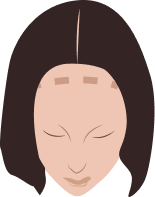
- Choose your hair loss type: Female Pattern Baldness (Ludwig Scale) or Traction Alopecia.
- Select the image that best represents your hair loss severity.
- Choose your hair texture, age range, and hair loss duration.
Tip: Take photos of your scalp under bright, natural light before starting to accurately assess thinning areas.
How to interpret graft calculator results?
Graft calculator results show an estimated range (minimum and maximum) of grafts needed to cover your balding areas based on your inputs. However, your actual needs may differ due to factors the calculator cannot evaluate.
What your numbers mean:
- Minimum estimate: Lowest grafts needed for basic coverage (30-35 grafts/cm²)
- Maximum estimate: Optimal grafts for full, natural density (50-60 grafts/cm²)
- Your ideal range: Most patients achieve excellent results somewhere in between
Use these estimates as a starting point for discussions with a hair transplant surgeon, who will assess donor capacity, scalp condition, and future hair loss patterns for precise planning.
How many grafts do you need for different areas?
Different scalp regions require different graft counts for natural-looking results. Here's a breakdown by treatment area:
| Area | Typical Range | Notes |
|---|
| Frontal hairline | 1,500 – 2,200 | Single-hair grafts create natural, irregular edge |
| Temples (both) | 400 – 800 | Essential for facial framing |
| Crown/vertex | 800 – 1,500 | Whorl pattern; may need higher density |
| Mid-scalp | 1,000 – 2,000 | Connects hairline to crown |
| Full coverage | 3,000 – 6,000+ | Often staged; donor-aware planning essential |
These numbers vary based on hair loss pattern, desired thickness, and individual hair characteristics. Curly hair typically requires fewer grafts than straight hair for the same visual coverage.
What measurements does a graft calculator consider?
The MedArt graft calculator considers 5 key measurements to determine optimal graft numbers:
- Balding area size: Measured in square centimeters (cm²) to determine total surface requiring coverage
- Current hair density: Number of existing hairs per cm² in thinning areas
- Hair texture: Straight, wavy, curly, or coily—affects coverage per graft
- Age: Predicts future hair loss patterns and plans appropriate coverage
- Hair loss progression: Estimated speed of past and future loss
The calculator combines these measurements to recommend minimum and maximum graft counts. However, it cannot measure donor density, scalp laxity, or microscopic hair characteristics that affect final requirements.
How much does a hair transplant cost in Turkey vs. Europe vs. USA?
Understanding hair transplant Turkey costs helps you plan effectively. Here's how graft pricing compares globally:
| Graft Count |
Turkey |
UK/Europe |
USA |
| 2,000 grafts | €1,700-€2,500 | €7,000-€14,000 | €9,000-€18,000 |
| 3,000 grafts | €2,300-€3,200 | €11,000-€22,000 | €14,000-€28,000 |
| 4,000 grafts | €2,800-€3,800 | €15,000-€30,000 | €18,000-€37,000 |
| 5,000 grafts | €3,200-€4,500 | €18,000-€37,000 | €23,000-€46,000 |
Why Turkey? Istanbul has become the world capital for hair transplants due to favorable exchange rates, lower operating costs, and surgeon experience (Turkish surgeons perform 500-1,000+ procedures annually vs. 50-100 in Western countries). Quality at reputable clinics meets or exceeds Western standards.
Note: At MedArt, we offer all-inclusive packages (€2,500-€3,500) with no per-graft limits—we use maximum viable grafts for your desired result. Packages include hotel, VIP transfers, and aftercare.
How accurate are online graft calculators?
Online graft calculators available to the public achieve 40-60% accuracy. They cannot account for individual variations in scalp laxity, donor area capacity, or future hair loss patterns.
Accuracy comparison:
- Generic online calculators: 40-60% accuracy (basic formulas, no clinical validation)
- In-person surgeon consultation: 90-95% accuracy (physical examination, microscopic analysis)
Always consult a hair transplant surgeon who can perform a physical examination and consider all relevant medical factors for precise graft calculations.
What are the limitations of graft calculators?
Graft calculators have 5 significant limitations that affect accuracy:
- Cannot assess scalp laxity: Determines how many grafts can be safely extracted from the donor area
- Cannot evaluate microscopic hair characteristics: Follicular unit composition and hair shaft diameter impact graft survival
- Cannot account for surgical technique variations: Surgeon skill affects graft placement density
- Limited future loss prediction: Especially for younger patients or those with aggressive hair loss
- Cannot factor in healing capacity: Blood vessels and individual healing influence graft survival rates
What is the difference between a graft calculator and surgeon assessment?
Graft calculators provide 40-60% accuracy, while surgeon assessments achieve 90-95% accuracy through physical examination and microscopic analysis.
| Factor | Graft Calculator | Surgeon Consultation |
|---|
| Balding area measurement | ✅ Good estimate | ✅ Precise measurement |
| Donor area evaluation | ❌ Cannot assess | ✅ Complete assessment |
| Scalp elasticity | ❌ Cannot assess | ✅ Physical testing |
| Microscopic hair analysis | ❌ Cannot assess | ✅ Trichoscopy examination |
| Future loss prediction | ⚠️ Age-based only | ✅ Family/hormone analysis |
| Surgical planning | ❌ Cannot provide | ✅ Technique selection |
Bottom line: Use calculators for preliminary estimates and budgeting, but always schedule a consultation for accurate surgical planning.
How do graft calculators help in hair transplant planning?
Despite limitations, graft calculators serve valuable purposes in your hair restoration journey:
- Cost estimation: Understand financial scope before emotional investment
- Treatment scope: Grasp the magnitude of your procedure (hours needed, potential for multiple sessions)
- Informed consultations: Ask better questions during surgeon meetings
- Realistic expectations: Understand that complete restoration may require 6,000+ grafts
- Clinic comparison: Evaluate different surgeons' recommendations against calculator baseline
However, graft calculators are preliminary planning tools—final surgical planning requires thorough in-person assessment by a qualified surgeon.
How do graft numbers influence hair transplant results?
Graft numbers directly determine density, coverage, and natural appearance of results:
- 20-30 grafts/cm²: Visible scalp, low satisfaction (40-50%)
- 30-40 grafts/cm²: Mild coverage, moderate satisfaction (55-70%)
- 40-50 grafts/cm²: Good coverage, high satisfaction (75-85%)—most common target
- 50-60 grafts/cm²: Dense coverage, very high satisfaction (85-95%)
The "tipping point": Patient satisfaction rises sharply once density reaches ~40 grafts/cm² and the scalp is no longer visible.
Quality matters as much as quantity—3,000 high-quality grafts (95% survival) often outperform 4,000 poorly-handled grafts (75% survival). Correct angle placement matching natural hair growth also contributes to natural appearance.
How are grafts placed for best results?
Grafts are placed considering natural hair growth angles, appropriate density, and strategic patterns:
- Hairline: Single-hair grafts at 40-45° angle, 30-35 grafts/cm², irregular pattern
- Mid-scalp: 2-3 hair grafts at 60-75° angle, 40-60 grafts/cm²
- Crown: Multi-hair grafts matching whorl pattern, highest density needed
Surgeons space grafts 0.8-1.2mm apart so each follicle receives adequate blood flow. They avoid uniform rows that create unnatural "doll-hair" appearance.
How does donor area viability impact graft numbers?
Donor area viability establishes the limit on extractable grafts:
- Total available: Men typically have 8,000-12,000 grafts in donor area
- Safe extraction: Only 50% can be removed without visible thinning
- Lifetime maximum: 6,000-8,000 grafts across all procedures
By technique:
- FUT (strip): Up to 4,000-5,000 grafts per session
- FUE: 2,000-4,000 grafts per session
Factors affecting donor capacity include density (80-100 follicles/cm² is excellent), scalp laxity (loose scalp = more grafts), and hair characteristics (thicker hair = better coverage). For extensive baldness, multiple sessions spaced 8-12 months apart may be needed.
How does graft number affect patient satisfaction?
Graft number significantly affects satisfaction by determining final density and coverage:
- Satisfaction rises sharply once density reaches 40+ grafts/cm² (scalp no longer visible)
- Patients who understand donor limits and potential need for multiple sessions report higher satisfaction
- Long-term success improves when future hair loss is factored into the transplant plan
Accurate graft calculation produces a seamless blend with existing hair and meets patient expectations. Unrealistic expectations about coverage from limited grafts lead to disappointment.
How does a graft calculator help set realistic expectations?
Graft calculators help patients by:
- Providing clear insight into grafts needed for various density levels
- Helping prepare for the financial aspects of the procedure
- Offering objective numerical estimates based on measurable factors
- Illustrating graft distribution priorities across scalp regions
- Serving as a starting point for surgeon discussions about realistic outcomes
- Lowering disappointment risk by setting expectations before emotional investment
- Helping patients understand why multiple sessions might be necessary
Accurate estimates support informed treatment decisions and align surgical results with patient expectations.
Is 3000 grafts a lot for a hair transplant?
3,000 grafts is a moderate-to-large hair transplant that covers most common hair loss patterns. It's the most frequently performed graft count and provides significant, natural-looking results for most patients.
What 3,000 grafts typically achieves:
- Coverage area: 60-100 cm² (frontal hairline + mid-scalp or partial crown)
- Total hairs: 6,000-7,500 hairs (at 2-2.5 hairs per graft average)
- Procedure time: 6-8 hours
- Best suited for: Norwood 3-4 hair loss patterns
For reference: 1,500 grafts is considered small (hairline only), 3,000 is moderate-large, and 5,000+ is a mega-session requiring excellent donor area.
How long does a hair transplant last?
Transplanted hair is permanent and lasts a lifetime. Hair grafts from the donor area (back and sides of head) are genetically resistant to DHT—the hormone that causes male pattern baldness. When transplanted to balding areas, they retain this resistance permanently.
Results timeline:
- Days 1-14: Transplanted hairs visible in scalp
- Weeks 2-4: Shock loss phase (transplanted hairs shed—this is normal)
- Months 3-4: New growth begins emerging
- Months 6-9: Significant visible improvement
- Month 12: Final results visible
- Lifetime: Transplanted hair continues growing permanently
Important: While transplanted hair is permanent, your native (non-transplanted) hair may continue thinning. Many patients use finasteride or minoxidil to protect existing hair.
What is the success rate of hair transplants in Turkey?
Reputable Turkish clinics achieve 90-98% graft survival rates, comparable to or exceeding Western standards. Turkey performs more hair transplants than any other country, giving surgeons extensive experience.
Key success factors:
- Surgeon experience: Turkish surgeons perform 500-1,000+ procedures yearly (vs. 50-100 in US/EU)
- Technique access: Latest Sapphire FUE and DHI methods widely available
- Specialized teams: 10-15 trained technicians per procedure for efficient graft handling
- Modern facilities: JCI-accredited hospitals with international standards
How to verify quality: Check Google reviews (4.5+ rating), request video consultation with the surgeon, ask for patient references, and verify the surgeon performs the procedure (not just technicians).
Ready for your personalized assessment?
Use the calculator above to get your initial graft estimate in under 60 seconds. Then schedule a free consultation with our team for a precise assessment including donor area evaluation, scalp analysis, and personalized treatment plan.
Contact MedArt Hair Istanbul:
- WhatsApp: +90 542 204 47 77 (24/7)
- Email: info@medarthair.com
- Free video consultation available
Our multilingual team speaks English, German, Italian, and Russian. Most patients stay just 2-3 days in Istanbul—you can fly home 48-72 hours after your FUE procedure. Meet our team or contact us to get started.